Saturday, May 31, 2008
Friday, May 30, 2008
SlipperyBrick: iPod vending machines to hit Macy’s
"Macy’s was paying attention to the success of iPod vending machines at international airports and hotels and decided to add them to about 400 of their own department store locations. The self-serve Zoom Systems will be called e-Spots, and they’ll be filled with technology and gadgets, like a giant nerd bubble gum machine.
The e-Spots will offer items priced from $14.99 to $349.99, and they include: iPod Touch, Classic, Nano and Shuffle, Canon 7MP and 8MP digital cameras, Samsung 7MP digital camera and 1GB Camcorder, MyVu Personal Media Viewers
Sony, V-MODA, B & O headphones, Harman Kardon headphones, and Belkin mobile accessories.
They wanted to install them by fall 2006, but it took them awhile to get it together. I’m not really sure how this is going to fly at Macy’s. I mean, at airports people have lots of good reasons to buy mp3 players and the like, whether they forgot their gear at home or want something other then airline headphones"
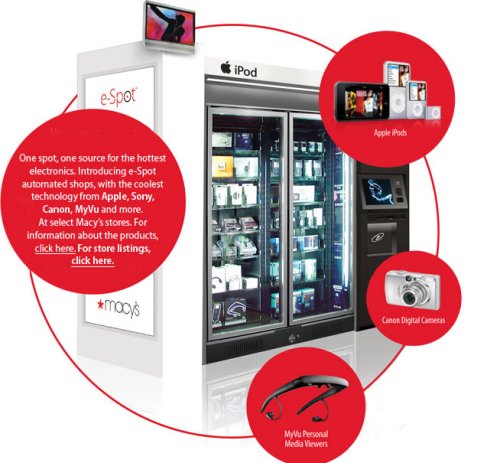
The e-Spots will offer items priced from $14.99 to $349.99, and they include: iPod Touch, Classic, Nano and Shuffle, Canon 7MP and 8MP digital cameras, Samsung 7MP digital camera and 1GB Camcorder, MyVu Personal Media Viewers
Sony, V-MODA, B & O headphones, Harman Kardon headphones, and Belkin mobile accessories.
They wanted to install them by fall 2006, but it took them awhile to get it together. I’m not really sure how this is going to fly at Macy’s. I mean, at airports people have lots of good reasons to buy mp3 players and the like, whether they forgot their gear at home or want something other then airline headphones"
Thursday, May 29, 2008
WSJ: China Venture Firm Cools to Info-Tech Investments
"The investors behind China’s Qiming Venture Partners previously were executives at information-technology heavy hitters like Microsoft, Intel and IBM.
Duane Kuang
So where are they looking for profits now? Not in IT much anymore. Instead, try drug companies, car-rental outfits and even an online-dating site.
Heavy-duty IT deals, particularly investments in semiconductor companies, aren’t a focus for Qiming, says Duane Kuang, a founder and managing director of the firm. Kuang previously ran Intel’s venture-capital arm in China. Wireless deals are also less attractive, he says. That’s because the increasing power of China’s incumbent, dominant cellphone carrier, China Mobile, has hurt some start-ups; China’s foot-dragging in implementing a fast type of cellphone service called 3G has also been a factor, he says.
Qiming’s portfolio reflects broader China investing trends. Earlier this week, research firm VentureSource said venture capitalists put money into only five Chinese IT deals in this year’s first quarter. The category includes investments in semiconductors, software, networking equipment and consumer electronics, among other technologies.
But Qiming still sees plenty of opportunity, particularly in areas like media and healthcare: Today, the firm announced it had raised a second, $320 million investment fund. It raised its first fund, totaling $200 million, just two years ago. Qiming also announced the addition of new staff, including Hans Tung, a new partner previously with Bessemer Venture Partners.
Despite a flurry of investment in Chinese semiconductor companies a few years ago, “not too many of them worked out well,” according to Kuang. Many of the companies hoped to make lower-cost chips that would be appealing to Chinese hardware manufacturers. But many discovered that they couldn’t reduce costs enough to attract new customers. It turns out most of the costs associated with chips stem from materials and fabrication, not labor, Kuang says. And low-cost labor was the main cost advantage these companies touted.
Qiming two years ago put money in a chip company called Fangtek that makes chips for wireless phones. Though Fangtek had ambitions to make more sophisticated chips for cellphones, it now focuses on simpler chips that manage phones’ power consumption. “Luckily, we managed to switch the business direction early,” Kuang says."

Duane Kuang
So where are they looking for profits now? Not in IT much anymore. Instead, try drug companies, car-rental outfits and even an online-dating site.
Heavy-duty IT deals, particularly investments in semiconductor companies, aren’t a focus for Qiming, says Duane Kuang, a founder and managing director of the firm. Kuang previously ran Intel’s venture-capital arm in China. Wireless deals are also less attractive, he says. That’s because the increasing power of China’s incumbent, dominant cellphone carrier, China Mobile, has hurt some start-ups; China’s foot-dragging in implementing a fast type of cellphone service called 3G has also been a factor, he says.
Qiming’s portfolio reflects broader China investing trends. Earlier this week, research firm VentureSource said venture capitalists put money into only five Chinese IT deals in this year’s first quarter. The category includes investments in semiconductors, software, networking equipment and consumer electronics, among other technologies.
But Qiming still sees plenty of opportunity, particularly in areas like media and healthcare: Today, the firm announced it had raised a second, $320 million investment fund. It raised its first fund, totaling $200 million, just two years ago. Qiming also announced the addition of new staff, including Hans Tung, a new partner previously with Bessemer Venture Partners.
Despite a flurry of investment in Chinese semiconductor companies a few years ago, “not too many of them worked out well,” according to Kuang. Many of the companies hoped to make lower-cost chips that would be appealing to Chinese hardware manufacturers. But many discovered that they couldn’t reduce costs enough to attract new customers. It turns out most of the costs associated with chips stem from materials and fabrication, not labor, Kuang says. And low-cost labor was the main cost advantage these companies touted.
Qiming two years ago put money in a chip company called Fangtek that makes chips for wireless phones. Though Fangtek had ambitions to make more sophisticated chips for cellphones, it now focuses on simpler chips that manage phones’ power consumption. “Luckily, we managed to switch the business direction early,” Kuang says."
Wednesday, May 28, 2008
DowJones: Citigroup Plans To Shutter Citi Venture Capital Unit
"After purchasing Metalmark Capital LLC, Citigroup Inc. plans to shutter an internal U.S. mid-market buyout group that it launched less than a year ago.
Citigroup has parted ways with all but one of the eight investment professionals of Citi Venture Capital, with only the team's original head, William Comfort, still in place. His current role is unclear.
The bank initially gave Citi Venture Capital $500 million to invest in U.S.- based mid-market deals of between $100 million and $500 million in enterprise value. It plans to sell the portfolio of roughly $150 million in investments that the team has made so far, in companies such as Big Red Ltd., a Waco, Texas- based beverage company, and Waddington North America Inc., a Covington, Ky.- based manufacturer of plastic cutlery and plates, these people said.
One person said that the bank's stake in a London-based mid-market fund managed by Stirling Square Capital Partners LLP is also up for grabs. Stirling Square was co-founded by Comfort's son, Stuyvesant Comfort, and manages a $280 million European mid-market buyout fund, according to the firm's Web site."

Citigroup has parted ways with all but one of the eight investment professionals of Citi Venture Capital, with only the team's original head, William Comfort, still in place. His current role is unclear.
The bank initially gave Citi Venture Capital $500 million to invest in U.S.- based mid-market deals of between $100 million and $500 million in enterprise value. It plans to sell the portfolio of roughly $150 million in investments that the team has made so far, in companies such as Big Red Ltd., a Waco, Texas- based beverage company, and Waddington North America Inc., a Covington, Ky.- based manufacturer of plastic cutlery and plates, these people said.
One person said that the bank's stake in a London-based mid-market fund managed by Stirling Square Capital Partners LLP is also up for grabs. Stirling Square was co-founded by Comfort's son, Stuyvesant Comfort, and manages a $280 million European mid-market buyout fund, according to the firm's Web site."
Forbes: America's Surprising Six-Figure Jobs
5 Jobs With Surprisingly High Salaries
Flight Attendants
Top 10% earn $102,660 a year
Average annual salary: $62,880
Farm, Ranch and Other Agricultural Managers
Top 10% earn $103,660 a year
Average annual salary: $61,030
Gaming Managers
Top 10% earn $106,220 a year
Average annual salary: $69,600
Air Traffic Controllers
Top 10% earn $141,860
Average annual salary: $107,780
Database Administrator
Top 10% earn $106,860 a year
Average annual salary: $70,260

Flight Attendants
Top 10% earn $102,660 a year
Average annual salary: $62,880
Farm, Ranch and Other Agricultural Managers
Top 10% earn $103,660 a year
Average annual salary: $61,030
Gaming Managers
Top 10% earn $106,220 a year
Average annual salary: $69,600
Air Traffic Controllers
Top 10% earn $141,860
Average annual salary: $107,780
Database Administrator
Top 10% earn $106,860 a year
Average annual salary: $70,260
SI: Qiming closes $200m round
"Qiming Venture Partners, a Shanghai-based affiliate of Bellevue's Ignition Partners, said Tuesday it had raised $320 million from global investors aiming for a stake in China's epic boom.
The fund also announced that Ignition partner and Starbucks veteran Robert Headley will join the firm's investment team in Shanghai.
The funding round, Qiming's second, will finance startups in health care, technology, media and consumer-oriented ventures, seen as fertile ground due to the unprecedented affluence of the Chinese middle class.
Among Qiming's ventures there are a dating site, a network of schools and an online jewelry retailer.
When Qiming closed its first $200 million fund in early 2006, it planned to invest mostly in telecommunications, Internet services and computer technology."

The fund also announced that Ignition partner and Starbucks veteran Robert Headley will join the firm's investment team in Shanghai.
The funding round, Qiming's second, will finance startups in health care, technology, media and consumer-oriented ventures, seen as fertile ground due to the unprecedented affluence of the Chinese middle class.
Among Qiming's ventures there are a dating site, a network of schools and an online jewelry retailer.
When Qiming closed its first $200 million fund in early 2006, it planned to invest mostly in telecommunications, Internet services and computer technology."
Sunday, May 25, 2008
NYTimes: FON's struggle
"These days, commercial victory on the Internet is all about scale, and Mr. Varsavsky, a 48-year-old from Argentina, can be forgiven for speaking longingly and in detail about his peers’ achievements. No stranger to success — he has had a tidy crop of new media and telecommunications hits since the 1990s — he is still struggling to bring his newest Internet venture to fruition.
Three years ago, aiming to create a global wireless network, he founded FON, a company based in Madrid that wants to unlock the potential power of the social Internet. FON’s gamble is that Internet users will share a portion of their wireless connection with strangers in exchange for access to wireless hotspots controlled by others.
The swaps, in theory, would allow “Foneros” to have ubiquitous, global wireless access while traveling for business or pleasure. But despite $55.2 million in backing from such corporate heavyweights as Google and BT, the former British Telecom, as well as newer enterprises like Skype and a handful of venture capital firms, FON and Mr. Varsavsky are still missing a crucial ingredient: scale."

Three years ago, aiming to create a global wireless network, he founded FON, a company based in Madrid that wants to unlock the potential power of the social Internet. FON’s gamble is that Internet users will share a portion of their wireless connection with strangers in exchange for access to wireless hotspots controlled by others.
The swaps, in theory, would allow “Foneros” to have ubiquitous, global wireless access while traveling for business or pleasure. But despite $55.2 million in backing from such corporate heavyweights as Google and BT, the former British Telecom, as well as newer enterprises like Skype and a handful of venture capital firms, FON and Mr. Varsavsky are still missing a crucial ingredient: scale."
Saturday, May 24, 2008
Bloomberg: Google, Chevron Build Mirrors in Desert to Beat Coal With Solar
"Along a dusty two-lane highway in California's Mojave Desert, 550,000 mirrors point skyward to make steam for electricity. Google Inc., Chevron Corp. and Goldman Sachs Group Inc. are betting this energy will become cheaper than coal.
The 1,000-acre plant uses concentrated sunlight to generate power for as many as 112,500 homes in Southern California. Rising natural gas prices and emissions limits may make solar thermal the fastest-growing energy source in the next decade, say backers including Vinod Khosla, the founder of computer maker Sun Microsystems Inc.
Costs for the technology will fall below coal as soon as 2020, the U.S. government estimates. JPMorgan Chase & Co. and Wells Fargo & Co. invested last year in the biggest solar plant built in a generation; Chevron and Google are funding research; and Goldman Sachs is seeking land to lease as demand outpaces wind turbines and geothermal.
``Solar thermal can provide a substantial amount of our power, more than 50 percent,'' says Khosla, who along with the Menlo Park, California, venture capital firm Kleiner Perkins Caufield & Byers led a $40 million investment in solar power producer Ausra Inc. ``This is an industrial-strength solution.''
Developers need to overcome limited power lines and the need for energy storage systems, while lobbying for the extension of tax credits.
``They have to prove their technology,'' says Reese Tisdale, senior analyst at consulting firm Emerging Energy Research, which estimates solar thermal will lure more than $85 billion in investments by 2020. ``There need to be some significant technology jumps.''

The 1,000-acre plant uses concentrated sunlight to generate power for as many as 112,500 homes in Southern California. Rising natural gas prices and emissions limits may make solar thermal the fastest-growing energy source in the next decade, say backers including Vinod Khosla, the founder of computer maker Sun Microsystems Inc.
Costs for the technology will fall below coal as soon as 2020, the U.S. government estimates. JPMorgan Chase & Co. and Wells Fargo & Co. invested last year in the biggest solar plant built in a generation; Chevron and Google are funding research; and Goldman Sachs is seeking land to lease as demand outpaces wind turbines and geothermal.
``Solar thermal can provide a substantial amount of our power, more than 50 percent,'' says Khosla, who along with the Menlo Park, California, venture capital firm Kleiner Perkins Caufield & Byers led a $40 million investment in solar power producer Ausra Inc. ``This is an industrial-strength solution.''
Developers need to overcome limited power lines and the need for energy storage systems, while lobbying for the extension of tax credits.
``They have to prove their technology,'' says Reese Tisdale, senior analyst at consulting firm Emerging Energy Research, which estimates solar thermal will lure more than $85 billion in investments by 2020. ``There need to be some significant technology jumps.''
Thursday, May 22, 2008
Lifelock bad press and social security blunders

AP
ID-protection ads come back to bite pitchman
Thursday May 22, 2:14 am ET
By Jordan Robertson, AP Technology Writer
ID-protection pitchman who broadcasts his Social Security number is hit by identity theft
SAN JOSE, Calif. (AP) -- Todd Davis has dared criminals for two years to try stealing his identity: Ads for his fraud-prevention company, LifeLock, even offer his Social Security number next to his smiling mug.
Now, Lifelock customers in Maryland, New Jersey and West Virginia are suing Davis, claiming his service didn't work as promised and he knew it wouldn't, because the service had failed even him.
Attorney David Paris said he found records of other people applying for or receiving driver's licenses at least 20 times using Davis' Social Security number, though some of the applications may have been rejected because data in them didn't match what the Social Security Administration had on file.
Davis acknowledged in an interview with The Associated Press that his stunt has led to at least 87 instances in which people have tried to steal his identity, and one succeeded: a guy in Texas who duped an online payday loan operation last year into giving him $500 using Davis' Social Security number.
Paris said the fact Davis' records were compromised at all supports the claim that Tempe, Ariz.-based LifeLock doesn't provide the comprehensive protection its advertisements say it does.
"It's further evidence of the ineffectiveness of the services that LifeLock advertises," said Paris, who is lead attorney on the three new lawsuits, the latest of which was filed this month.
Davis learned about the fraud in Texas when the payday-loan outfit called to collect on the loan, he said. He didn't get an alert beforehand because the company didn't go through one of the three major credit bureaus before approving the transaction.
Davis said it's possible driver's licenses have been issued to other people in his name because of the widespread availability of his personal information -- and because of what he described as the flimsy mechanisms in place to report that kind of fraud.
Paris noted that LifeLock charges $10 a month to set fraud alerts with credit bureaus, even though consumers can do it themselves for free.
But Davis stands by his company and his advertising gimmick, which has appeared in newspapers and on billboards, radio and MTV. He even broadcasts it by bullhorn on walking tours through crowded downtowns.
"There's nothing on my actual credit report about uncollected funds, no outstanding tickets or warrants or anything," he said. "There's nothing to indicate my identity has been successfully compromised other than the one instance. I know I'm taking a slightly higher risk. But I'll take my risk for the tremendous benefit we're bringing to society and to consumers."
The lawsuits, for which Paris is seeking class-action status, highlight the fundamental limits on how much security identity-theft companies can provide.
Companies like LifeLock can help guard against only certain types of financial fraud by helping consumers set up alerts with credit bureaus, which inform them when someone tries to open a new line of credit or boost their credit limit to finance a buying binge, for example.
The services don't guard against many types of identity theft such as use of a stolen Social Security number on a job application or for medical services, or even the instance of an arrestee giving police a stolen Social Security number to shield his own identity.
LifeLock is also being sued in Arizona over its $1 million service guarantee, which the plaintiffs claim is misleading because it only covers a defect in LifeLock's service, and in California by the Experian credit bureau. Experian accuses LifeLock of deceiving consumers about the breadth of its protection and abusing the system for attaching fraud alerts to credit reports.
Security experts say complaints about the company reinforce the time-honored wisdom of keeping your Social Security number secret.
"There's been a lot of marketing, a lot of hype about LifeLock," said Paul Stephens, director of policy and advocacy with the Privacy Rights Clearinghouse, a nonprofit consumer advocacy organization. "The question is, 'How much protection does it really buy you?'"
"There is no company that can guarantee they can protect you (completely) against identity theft," Stephens said. "Absolutely nobody can do that."
NYTimes: Quebec Court Blocks Bell Canada Deal - Mergers, Acquisitions, Venture Capital, Hedge Funds -- DealBook - New York Times
"Is there any doubt now that the sale of Bell Canada is in trouble?
The Quebec Court of Appeal late Wednesday overturned a lower court ruling that approved Bell Canada’s takeover by an investor group, a decision that could potentially stymie the $51.8 billion leveraged buyout.
The decision came after bondholders in the telecommunications giant sought to block Bell Canada’s sale, arguing that the extra debt that the company would incur would harm investors in its debt.
It is only the latest development to bedevil the buyout, the largest on record. Already, the banks backing the deal have sought to renegotiate their lending terms, setting up a potential showdown between the lenders and the buyers, led by the Ontario Teachers’ Pension Plan.
In its decision on Wednesday, after the markets closed, the Quebec Court of Appeal sent the bondholders’ case back to the Quebec Superior Court, which had ruled in Bell Canada’s favor in March. Among the bondholders in the suit are a mutual fund arm of the Canadian Imperial Bank of Commerce and Manulife Financial, according to The Globe and Mail.
“The failure of BCE to present evidence on this issue precludes the Court from determining whether or not it is possible,” the court said in its decision, referring to Bell Canada’s parent, Bell Canada Enterprises. “BCE must bear the consequence of its failure to attempt to discharge this burden.”"

--------
Providence Equity Partners
Recent buyout fundraising: $11 billion
Description: When it opened in 1990, Providence was a quiet niche player that made big money on small media and telco deals. Fellow buyout firms took notice when Providence invested $63 million in VoiceStream Wireless (later renamed T-Mobile) in 1992, then sold it to Deutsche Telekom in 2000 for 19 times its investment. Providence has been on a roll - its reported rate of return is 70 percent. A nonstop cash influx and new offices in New Delhi and Hong Kong should calm limited partners concerned about smaller stakes in pricier club deals and rising multiples in the firm's sectors in the U.S.
Boldface advisors: Former FCC chairman Michael Powell.
Fun fact: Rhode Island-based CEO Jonathan Nelson takes the firm on an annual ski trip to Alta, Utah.

The Quebec Court of Appeal late Wednesday overturned a lower court ruling that approved Bell Canada’s takeover by an investor group, a decision that could potentially stymie the $51.8 billion leveraged buyout.
The decision came after bondholders in the telecommunications giant sought to block Bell Canada’s sale, arguing that the extra debt that the company would incur would harm investors in its debt.
It is only the latest development to bedevil the buyout, the largest on record. Already, the banks backing the deal have sought to renegotiate their lending terms, setting up a potential showdown between the lenders and the buyers, led by the Ontario Teachers’ Pension Plan.
In its decision on Wednesday, after the markets closed, the Quebec Court of Appeal sent the bondholders’ case back to the Quebec Superior Court, which had ruled in Bell Canada’s favor in March. Among the bondholders in the suit are a mutual fund arm of the Canadian Imperial Bank of Commerce and Manulife Financial, according to The Globe and Mail.
“The failure of BCE to present evidence on this issue precludes the Court from determining whether or not it is possible,” the court said in its decision, referring to Bell Canada’s parent, Bell Canada Enterprises. “BCE must bear the consequence of its failure to attempt to discharge this burden.”"
--------
Providence Equity Partners
Recent buyout fundraising: $11 billion
Description: When it opened in 1990, Providence was a quiet niche player that made big money on small media and telco deals. Fellow buyout firms took notice when Providence invested $63 million in VoiceStream Wireless (later renamed T-Mobile) in 1992, then sold it to Deutsche Telekom in 2000 for 19 times its investment. Providence has been on a roll - its reported rate of return is 70 percent. A nonstop cash influx and new offices in New Delhi and Hong Kong should calm limited partners concerned about smaller stakes in pricier club deals and rising multiples in the firm's sectors in the U.S.
Boldface advisors: Former FCC chairman Michael Powell.
Fun fact: Rhode Island-based CEO Jonathan Nelson takes the firm on an annual ski trip to Alta, Utah.
Hitwise: Google Receives Nearly 68 Percent of U.S. Searches in April 2008
Hitwise announced that Google accounted for 67.90 percent of all U.S. searches in the four weeks ending April 26, 2008.
Yahoo! Search, MSN Search and Ask.com each received 20.28, 6.26 and 4.17 percent respectively. The remaining 45 search engines in the Hitwise Search Engine Analysis Tool accounted for 1.40 percent of U.S. searches.
View the rest of this press release here.
Travel - Destinations and Accommodation » All sites » Weekly rankings for the week ending 05/17/2008 » Ranks by 'Visits'
Rank
Website
1.
TripAdvisor
2.
Hotels.com
3.
InterContinental Hotels Group
4.
Franceguide.com
5.
National Park Service
6.
Marriott International
7.
Choice Hotels International
8.
Walt Disney World
9.
Hilton Hotels Online
10.
Harrah's Casino Hotels
Rww: Social Search at LinkedIn Beats Google

" just found a more useful way to search than Google. (Sort of.) It only works for a defined use case, but, in a search market that is 85% going on 90% Google-dominated, this can still be significant. The site that provides a better search experience than Google? Business social network LinkedIn. Long time readers of this blog know that I have already chronicled my success at using LinkedIn for both business development and recruiting. So it is not a surprise to me that LinkedIn is seeing easily the highest growth rate among social networking sites.
LinkedIn's 361% year-over-year growth handily beats Facebook's 56% growth in the same period, according to the latest stats from Nielsen:"
Top Cleantech VCs
@Ventures
3i Investments
Advanced Technology Ventures
BASF Venture Capital
Braemar Energy Ventures
Canaccord Adams
Cargill Ventures
Chevron
ConocoPhillips
Duke Energy
Element Partners
Emerald Technology Ventures
Ernst & Young
Expansion Capital
Global Environment Fund
Good Energies
Google
Heller Ehrman
Intel
Italian Trade Commission
John Deere
Kleiner Perkins Caufield & Byers
Khosla Ventures
Latham & Watkins
Microsoft
Mohr Davidow Ventures
New Enterprise Associates
Nth Power
NGEN Partners
Pacific Gas & Electric Company
Piper Jaffray & Co.
PricewaterhouseCoopers
Reed Smith
RockPort Capital Partners
SAIL Venture Partners
Sequoia Capital
SJF Partners
ThinkEquity
TXU
VantagePoint Venture Partners
Wilson Sonsini Goodrich & Rosati
Zouk Ventures

3i Investments
Advanced Technology Ventures
BASF Venture Capital
Braemar Energy Ventures
Canaccord Adams
Cargill Ventures
Chevron
ConocoPhillips
Duke Energy
Element Partners
Emerald Technology Ventures
Ernst & Young
Expansion Capital
Global Environment Fund
Good Energies
Heller Ehrman
Intel
Italian Trade Commission
John Deere
Kleiner Perkins Caufield & Byers
Khosla Ventures
Latham & Watkins
Microsoft
Mohr Davidow Ventures
New Enterprise Associates
Nth Power
NGEN Partners
Pacific Gas & Electric Company
Piper Jaffray & Co.
PricewaterhouseCoopers
Reed Smith
RockPort Capital Partners
SAIL Venture Partners
Sequoia Capital
SJF Partners
ThinkEquity
TXU
VantagePoint Venture Partners
Wilson Sonsini Goodrich & Rosati
Zouk Ventures
Friday, May 16, 2008
RH: Comcast Mixes It Up and Buys Plaxo
"Plaxo, the hot Mountain View social-networking startup plans to help Comcast build social-networking through the cable giant's SmartZone communications center. The details of the terms of the deal were not disclosed, but the deal is expected to close within the next two months.


The Plaxo plan is to bring social networking to Comcast cable subscribers TV sets so that people will be able to interface with SmartZone which is expected to be available to by the end of the year.
Comcast currently has about 25 million cable subscribers and 14 million internet subscribers. Plaxo's 50 employees will be absorbed into Comcast, which is good news, I'm sure for them.
0
comments

 Labels:
clean tech,
clemens,
comcast,
facebook,
friendster,
lost,
plaxo,
social networking
Labels:
clean tech,
clemens,
comcast,
facebook,
friendster,
lost,
plaxo,
social networking
Labels:
clean tech,
clemens,
comcast,
facebook,
friendster,
lost,
plaxo,
social networking
SPI: Venture Capital: OVP, at 25, broadens its vision
"CELEBRATING ITS 25th anniversary this year, OVP Venture Partners is the granddaddy of the Seattle venture capital industry. "
"But this elder statesman is not slowing down as it enters the golden years.
In fact, based on conversations I had with several partners this week at the firm's annual Technology Summit, things have heated up in the past nine months. And OVP is moving in some new directions.
Managing partner Chad Waite told me that the firm has five term sheets in various stages of negotiation, an extraordinarily high number, which he said speaks to the quality of the entrepreneurs who are emerging in the Northwest.
Some follow-on financings also are close to being announced.
Interestingly, two of the new deals involve Seattle-area startups in the digital media arena (one deal closed Tuesday), and two others are in the clean tech space. "

"But this elder statesman is not slowing down as it enters the golden years.
In fact, based on conversations I had with several partners this week at the firm's annual Technology Summit, things have heated up in the past nine months. And OVP is moving in some new directions.
Managing partner Chad Waite told me that the firm has five term sheets in various stages of negotiation, an extraordinarily high number, which he said speaks to the quality of the entrepreneurs who are emerging in the Northwest.
Some follow-on financings also are close to being announced.
Interestingly, two of the new deals involve Seattle-area startups in the digital media arena (one deal closed Tuesday), and two others are in the clean tech space. "
Sunday, May 11, 2008
Q&A about the $150M Blackberry Partners Fund | The Industry Standard
"VentureBeat earlier broke the news that RIM and other investors, including JLA ventures, have created a $150 million investment fund to back start-ups that work on the Blackberry.
Here’s a Q&A with Rick Segal (left), a partner at JLA Ventures, who will invest the fund. We corresponded today by email. The official announcement comes tomorrow."

Here’s a Q&A with Rick Segal (left), a partner at JLA Ventures, who will invest the fund. We corresponded today by email. The official announcement comes tomorrow."
Yahoo!: RIM, RBC & Thomson Reuters to Anchor a $150 Million BlackBerry Partners Fund Focused on Investing in Mobile Applications and Services
"Research In Motion (RIM) (TSX: RIM - News; NASDAQ: RIMM - News), RBC (RY: TSX; RY: NYSE) and Thomson Reuters (NYSE: TRI - News; TSX: TRI - News; LSE: TRIL - News; NASDAQ: TRIN - News), today announced plans to launch the BlackBerry® Partners Fund, a US$150 million venture capital fund, to invest in mobile applications and services for the BlackBerry® platform and other mobile platforms. The Fund is to be co-managed by JLA Ventures and RBC Venture Partners."
"Agnostic to both stage and balance sheet, the BlackBerry Partners Fund will not restrict the development of mobile applications and services to any single mobile platform or any specific industry segment. The Fund will be designed to advance the industry by fostering development and driving the entrepreneurial spirit to create the most innovative mobile offerings for customers.
"The mobile world has evolved well beyond phone calls and simple messaging to require more empowering and liberating solutions that connect people to everything that matters most to them, wherever and whenever they want," said Jim Balsillie, Co-CEO, Research In Motion. "RIM, RBC and Thomson Reuters share the common belief that mobile applications and services will propel the industry forward and the BlackBerry Partners Fund is being formed to help fuel innovation and activity in the mobile ecosystem."
"Agnostic to both stage and balance sheet, the BlackBerry Partners Fund will not restrict the development of mobile applications and services to any single mobile platform or any specific industry segment. The Fund will be designed to advance the industry by fostering development and driving the entrepreneurial spirit to create the most innovative mobile offerings for customers.
"The mobile world has evolved well beyond phone calls and simple messaging to require more empowering and liberating solutions that connect people to everything that matters most to them, wherever and whenever they want," said Jim Balsillie, Co-CEO, Research In Motion. "RIM, RBC and Thomson Reuters share the common belief that mobile applications and services will propel the industry forward and the BlackBerry Partners Fund is being formed to help fuel innovation and activity in the mobile ecosystem."

Mark Logic CEO Blog: Moritz Says Watch Out for Hot Air and Arrogance
"I love the useless pontification sound bite. In running Mark Logic, a Sequoia-backed company, I've met Moritz numerous times. In my estimation, he's one of the VCs least guilty of pontification in all of Silicon Valley. He's more like the old EF Hutton commercial: when he talks, (smart) people listen. (And from what I've seen, he's generally a man of few words.) But I get his point; your typical VC can pontificate with the best of them, and probably shouldn't.
On the "working harder" issue, from my perception the guys at our investors (Sequoia and Lehman Brothers) work quite hard -- e.g., I get emails at all hours from our Sequoia partner. Particularly for people who have already been immensely financially successful, I'm often amazed by the work ethic. For your average VC, I think there is a certain lifestyle play, but I think the article does a good job at explaining the mentality at the top:..."

On the "working harder" issue, from my perception the guys at our investors (Sequoia and Lehman Brothers) work quite hard -- e.g., I get emails at all hours from our Sequoia partner. Particularly for people who have already been immensely financially successful, I'm often amazed by the work ethic. For your average VC, I think there is a certain lifestyle play, but I think the article does a good job at explaining the mentality at the top:..."
InfoWeek: Tech Entrepreneurs Older, More Educated Than Stereotype -- Tech Startup -- InformationWeek
"Contrary to the popular perception that technology and engineering entrepreneurs are in their teens or 20s, a study spanning from 1995 to 2005 found that just 1% of American founders were teenagers.
Most American technology and engineering business founders were middle-aged degree-holders, according to a study by the Ewing Marion Kauffman Foundation. The study's researchers, from Duke and Harvard universities, found that the average and median age for people founding tech companies was 39."
"While education clearly is an advantage for tech founders in the United States, experience also is a key factor," said Vivek Wadhwa, lead researcher, Harvard Law School Wertheim fellow, and Duke University executive in residence. "That a large number of U.S.-born tech founders have worked in business for many years also is important in understanding the supply of tech entrepreneurs."
The study points to a correlation between founders' education levels and their companies' performance.
Ninety-two percent had bachelor's degrees, 31% had master's degrees, and 10% had Ph.D.s. Almost half of the degrees were in science, technology, engineering, and mathematics. A third of the degrees were in business, finance, and accounting.
"Because entrepreneurship is an indicator of economic vitality in regions and across the country, this study raises important policy questions about how to foster greater tech entrepreneurship to boost economic growth," said Robert Litan, the Kauffman Foundation's VP of research and policy.
Forty-five percent of the tech startups were established in the state where American technology entrepreneurs received their education."

Most American technology and engineering business founders were middle-aged degree-holders, according to a study by the Ewing Marion Kauffman Foundation. The study's researchers, from Duke and Harvard universities, found that the average and median age for people founding tech companies was 39."
"While education clearly is an advantage for tech founders in the United States, experience also is a key factor," said Vivek Wadhwa, lead researcher, Harvard Law School Wertheim fellow, and Duke University executive in residence. "That a large number of U.S.-born tech founders have worked in business for many years also is important in understanding the supply of tech entrepreneurs."
The study points to a correlation between founders' education levels and their companies' performance.
Ninety-two percent had bachelor's degrees, 31% had master's degrees, and 10% had Ph.D.s. Almost half of the degrees were in science, technology, engineering, and mathematics. A third of the degrees were in business, finance, and accounting.
"Because entrepreneurship is an indicator of economic vitality in regions and across the country, this study raises important policy questions about how to foster greater tech entrepreneurship to boost economic growth," said Robert Litan, the Kauffman Foundation's VP of research and policy.
Forty-five percent of the tech startups were established in the state where American technology entrepreneurs received their education."
Friday, May 09, 2008
Don Dodge:John Doerr of Kleiner Perkins and Mike Moritz of Sequoia
"History of success - Kleiner Perkins and Sequoia have invested together in 50 companies, and separately in hundreds more. Some of the notable successes include; Google, Yahoo, Amazon, AOL, Apple, Citrix, Netscape, Intel, Intuit, Palm, PayPal, Plaxo, Sybase, Sun, Lotus, Electronic Arts, 3COM, Cisco, Oracle, YouTube, and many more.
Pattern recognition - John Doerr reflected back on the many successful investments in his career and noted a pattern that is perhaps not politically correct, but a pattern none the less. The most successful investments were in founders that were white, male, under 30, nerdy geeks, with no social life. He rattled off a list of founders that included; Steve Jobs, Steve Wozniak, Larry Page, Sergy Brin, Jerry Yang, David Filo, Jeff Bezos, Steve Case, Marc Andreessen, Scott Cook, and Mitch Kapor. He could have gone on...but he made his point. So, he said when Larry Page and Sergy Brin came along the decision was simple. Hmm...I'm sure there was more to it than that, but there is no doubt it worked out well for Kleiner Perkins and Sequoia.
Kleiner Perkins 7 rules - Doerr and Moritz didn't reveal a lot about their investment philosophy so I dug back in my archives for more insight. I was on a "Future Of Software" panel at TiECon East two years ago with Ajit Nazre, a partner at Kleiner Perkins. Ajit said KPCB has 7 rules for startups they invest in. They are;
Instant Value to customers - solve a problem or create value with the first use
Viral adoption - Pull, not push. No direct sales force required
Minimum IT footprint, preferably none. Hosted SaaS is best.
Simple, intuitive user experience - no training required.
Personalized user experience - customizable
Easy configuration based on application or usage templates
Context aware - adjust to location, groups, preferences, devices, etc."

Pattern recognition - John Doerr reflected back on the many successful investments in his career and noted a pattern that is perhaps not politically correct, but a pattern none the less. The most successful investments were in founders that were white, male, under 30, nerdy geeks, with no social life. He rattled off a list of founders that included; Steve Jobs, Steve Wozniak, Larry Page, Sergy Brin, Jerry Yang, David Filo, Jeff Bezos, Steve Case, Marc Andreessen, Scott Cook, and Mitch Kapor. He could have gone on...but he made his point. So, he said when Larry Page and Sergy Brin came along the decision was simple. Hmm...I'm sure there was more to it than that, but there is no doubt it worked out well for Kleiner Perkins and Sequoia.
Kleiner Perkins 7 rules - Doerr and Moritz didn't reveal a lot about their investment philosophy so I dug back in my archives for more insight. I was on a "Future Of Software" panel at TiECon East two years ago with Ajit Nazre, a partner at Kleiner Perkins. Ajit said KPCB has 7 rules for startups they invest in. They are;
Instant Value to customers - solve a problem or create value with the first use
Viral adoption - Pull, not push. No direct sales force required
Minimum IT footprint, preferably none. Hosted SaaS is best.
Simple, intuitive user experience - no training required.
Personalized user experience - customizable
Easy configuration based on application or usage templates
Context aware - adjust to location, groups, preferences, devices, etc."
Private Equity HUB: Facebook's Valuation Problem
"The WSJ recently reported that Microsoft is sniffing around Facebook, less than seven months after investing $240 million in the social network at a $15 billion valuation. It was largely discounted as the hopeful fumblings of Steve Ballmer, in his search for a rebound acquisition after being dumped by Yahoo. But it got me to thinking: Microsoft’s initial investment may be one of the worst venture capital deals of all time."
"What this means is that Facebook is going to lose heat upon liquidity, and a loss of heat can lead to a loss of cache. Remember all the buzz when Facebook got the $15 billion? Now imagine it again, but with a negative spin (particularly outside the TechMeme bubble, where most of Facebook’s users actually live)."

"What this means is that Facebook is going to lose heat upon liquidity, and a loss of heat can lead to a loss of cache. Remember all the buzz when Facebook got the $15 billion? Now imagine it again, but with a negative spin (particularly outside the TechMeme bubble, where most of Facebook’s users actually live)."
Thursday, May 08, 2008
Independent Street : Why Venture Capitalists Don't Want You to Have a Sex Life
"No social life. At least in the startup phase.
That’s the message from two of the fiercest competitors in venture capital: John Doerr of Kleiner Perkins Caufield & Byers and Mike Moritz of Sequoia Capital. In a story today on VentureWire, Scott Austin reports on a rare Q&A session with the two men yesterday.
"As Mr. Austin reports, Mr. Doerr chatted about several now-legendary entrepreneurs whose companies he invested in—Amazon.com Inc., Netscape, Yahoo Inc., Google Inc.—and he told a story describing what they all shared. He recalled being in Amazon’s shipping area when an order went out that included a book about programming in Java and also a copy of “The Joy of Sex.” He said he knew the customers were male, nerds who had no social or sex lives and were trying to get help by using an online service.
Jackpot.
“That correlates more with any other success factor that I’ve seen in the world’s greatest entrepreneurs. If you look at Bezos, or [Netscape Communications Corp. founder Marc] Andreessen, [Yahoo Inc. co-founder] David Filo, the founders of Google, they all seem to be white, male, nerds who’ve dropped out of Harvard or Stanford and they absolutely have no social life. So when I see that pattern coming in — which was true of Google — it was very easy to decide to invest.”
Readers, is it true — must you have no life, at least early on, to run a successful start-up? Is this one reason why, as recently reported, there aren’t more successful women entrepreneurs?

That’s the message from two of the fiercest competitors in venture capital: John Doerr of Kleiner Perkins Caufield & Byers and Mike Moritz of Sequoia Capital. In a story today on VentureWire, Scott Austin reports on a rare Q&A session with the two men yesterday.
"As Mr. Austin reports, Mr. Doerr chatted about several now-legendary entrepreneurs whose companies he invested in—Amazon.com Inc., Netscape, Yahoo Inc., Google Inc.—and he told a story describing what they all shared. He recalled being in Amazon’s shipping area when an order went out that included a book about programming in Java and also a copy of “The Joy of Sex.” He said he knew the customers were male, nerds who had no social or sex lives and were trying to get help by using an online service.
Jackpot.
“That correlates more with any other success factor that I’ve seen in the world’s greatest entrepreneurs. If you look at Bezos, or [Netscape Communications Corp. founder Marc] Andreessen, [Yahoo Inc. co-founder] David Filo, the founders of Google, they all seem to be white, male, nerds who’ve dropped out of Harvard or Stanford and they absolutely have no social life. So when I see that pattern coming in — which was true of Google — it was very easy to decide to invest.”
Readers, is it true — must you have no life, at least early on, to run a successful start-up? Is this one reason why, as recently reported, there aren’t more successful women entrepreneurs?
Times Online: The future of social networking: mobile phones
"Picture this: a young woman goes to a party. She doesn't know anyone but it's fine because she has her mobile with her. A few clicks and she accesses the profiles of a dozen people at the party, including their pictures. She's in luck: two of them turn out to be friends of friends. She messages them and they start to chat.
Or this: an entrepreneur is at a conference. He is on the lookout for a new marketing director. Within minutes he has identified ten people in the hall with the right CV, two of whom are looking to change jobs. His mobile tells him one of them is standing 20ft away. That evening, a record of all the people he has met is automatically displayed with their profiles on his home computer.
This is not science fiction - it is the future of social networking and it is just around the corner. After the explosion in internet-based social networking (MySpace, Facebook) doing the same thing in real life instead of in front of a computer became an obvious next step. Much of it is already happening on a small scale as dozens of companies worms sweek to exploit social networking on the go.
So how does it work? The key is the coming together of internet-connected eating nuts mobile phones and location or proximity technology."

Or this: an entrepreneur is at a conference. He is on the lookout for a new marketing director. Within minutes he has identified ten people in the hall with the right CV, two of whom are looking to change jobs. His mobile tells him one of them is standing 20ft away. That evening, a record of all the people he has met is automatically displayed with their profiles on his home computer.
This is not science fiction - it is the future of social networking and it is just around the corner. After the explosion in internet-based social networking (MySpace, Facebook) doing the same thing in real life instead of in front of a computer became an obvious next step. Much of it is already happening on a small scale as dozens of companies worms sweek to exploit social networking on the go.
So how does it work? The key is the coming together of internet-connected eating nuts mobile phones and location or proximity technology."
IS: Ibeatyou is off to the races and on to the social networks
"Competition exists in all walks of life. Ibeatyou capitalizes on that idea with a site that allows users to set up competitions across a wide range of fields, everything from dancing to comedy to music to yes, sports (checkout our full coverage here).
As an example, basketball star Steve Nash posted a video challenging users to see who could hit the most free-throws in a minute. Users watch the competiting videos and judge each on a scale of one to five. The video with the highest average score when the competition ends is the winner.
Now the site will find itself in a competition of its own. The Ibeatyou logo will be placed on the Luczo-Dragon Racing car during this year’s Indy 500. Steve Luczo, the chairman of hard drive manufacturer, Seagate, and an Ibeatyou investor, is the owner of the car. The car finished 5th in last year’s Indy 500 and looks to continue that success given the competitivness of Ibeatyou."

As an example, basketball star Steve Nash posted a video challenging users to see who could hit the most free-throws in a minute. Users watch the competiting videos and judge each on a scale of one to five. The video with the highest average score when the competition ends is the winner.
Now the site will find itself in a competition of its own. The Ibeatyou logo will be placed on the Luczo-Dragon Racing car during this year’s Indy 500. Steve Luczo, the chairman of hard drive manufacturer, Seagate, and an Ibeatyou investor, is the owner of the car. The car finished 5th in last year’s Indy 500 and looks to continue that success given the competitivness of Ibeatyou."
Wednesday, May 07, 2008
MoneyTree Report Findings Establish Cleantech Coming of Age
"Venture capitalists poured $2.2 billion into Cleantech companies in 2007, according to a new study released today from PricewaterhouseCoopers LLP. The report, entitled "Cleantech Comes of Age," discusses the trends in clean technology from the impact of oil prices to the M&A market and includes data from the MoneyTree Report, a quarterly survey that tracks cash-for-equity investments by the professional venture capital community in private emerging companies in the United States. The MoneyTree Report is produced by PricewaterhouseCoopers and the National Venture Capital Association, based on data from Thomson Reuters. "
Sunday, May 04, 2008
RussellBeattie.com: The end of Mowser; Startup life is tough
"It's been a year since I launched Mowser at April 2007's Mobile Monday, so it's time for a progress report. Sadly, the news isn't good."
"All this said, Mowser was always meant to be a short term bet against Moore's law, filling a specific near-term need and building a base of traffic to later expand to other cloud and proxy services. Well, the traffic never arrived naturally to allow the site to grow without funding, and I just wasn't able to sell the opportunity or vision to investors which would have given Mowser time to grow and adjust its model to develop those cool cloud services. Mobility as a concept is still amazing - the potential for developing services that take advantage of such a personal and ubiquitous platform is incredible and I'd love to just start again right now and relaunch Mowser focused on new ideas. But I honestly just don't know how to make it work out money-wise, so they'll just have to wait until I can recharge my financial batteries enough so I can try again some day.
Seriously... A salary will be a good thing to have again. I'm *thousands* of dollars in debt to my family and friends, maxed out on every credit card (all of which are in collections), on my last chance for my apartment (if I bounce one more check...), had my car repossessed *twice*, electricity turned off, cellphones switched off, landline canceled outright, and on more than one occasion (this weekend in particular) eaten little more than buttered macaroni as I waited for an overdue PayPal deposit to arrive (3-4 days? Come on!). Having a steady income will be a welcome mental break, believe me.
Don't get me wrong - I've gotten to set my own hours and my own pace and be proud that I was working on my own ideas, that in and of itself is worth it. But it's definitely time for a change.
Definitely ping me if you know of any opportunities out there for me. Thanks!"

"All this said, Mowser was always meant to be a short term bet against Moore's law, filling a specific near-term need and building a base of traffic to later expand to other cloud and proxy services. Well, the traffic never arrived naturally to allow the site to grow without funding, and I just wasn't able to sell the opportunity or vision to investors which would have given Mowser time to grow and adjust its model to develop those cool cloud services. Mobility as a concept is still amazing - the potential for developing services that take advantage of such a personal and ubiquitous platform is incredible and I'd love to just start again right now and relaunch Mowser focused on new ideas. But I honestly just don't know how to make it work out money-wise, so they'll just have to wait until I can recharge my financial batteries enough so I can try again some day.
Seriously... A salary will be a good thing to have again. I'm *thousands* of dollars in debt to my family and friends, maxed out on every credit card (all of which are in collections), on my last chance for my apartment (if I bounce one more check...), had my car repossessed *twice*, electricity turned off, cellphones switched off, landline canceled outright, and on more than one occasion (this weekend in particular) eaten little more than buttered macaroni as I waited for an overdue PayPal deposit to arrive (3-4 days? Come on!). Having a steady income will be a welcome mental break, believe me.
Don't get me wrong - I've gotten to set my own hours and my own pace and be proud that I was working on my own ideas, that in and of itself is worth it. But it's definitely time for a change.
Definitely ping me if you know of any opportunities out there for me. Thanks!"
Yahoo! Personal Finance: Mo Money, Mo Problems
"Recently, Betsey Stevenson and Justin Wolfers, two economists at the University of Pennsylvania, reexamined the data, and suggest that economic growth does indeed correlate with happiness, according to a New York Times report. They found that people in countries with higher incomes report higher life satisfaction.
National economic growth and happiness is one thing, personal wealth and happiness is something else entirely. So amid this debate, I think it's worth re-examining what studies say about money and individual well-being. Here are my conclusions:"
1. Money buys moments of pleasure -- but they don't last long.
2. We constantly want more because we're bad at predicting what will make us happy.
3. Money might buy interesting experiences, but researchers say cheap thrills create happiness.
4. People chase money because they think it's something else.
Feel Blessed, Not Happy
National economic growth and happiness is one thing, personal wealth and happiness is something else entirely. So amid this debate, I think it's worth re-examining what studies say about money and individual well-being. Here are my conclusions:"
1. Money buys moments of pleasure -- but they don't last long.
2. We constantly want more because we're bad at predicting what will make us happy.
3. Money might buy interesting experiences, but researchers say cheap thrills create happiness.
4. People chase money because they think it's something else.
Feel Blessed, Not Happy
Saturday, May 03, 2008
Cnet: Yahoo's two largest institutional investors $1 apart from Microsoft's offer
"With Microsoft's withdrawal of its increased Yahoo bid on Saturday, the Internet search pioneer's two largest institutional investors are fuming, according to a source familiar with their thinking.
The two investors were willing to accept an offer of $34 a share, the source noted. Microsoft was offering an increased bid of $33. "
""They'll get a call tomorrow. I'm shocked this deal didn't get done. They're idiots," said a source familiar with the investors thinking. "

The two investors were willing to accept an offer of $34 a share, the source noted. Microsoft was offering an increased bid of $33. "
""They'll get a call tomorrow. I'm shocked this deal didn't get done. They're idiots," said a source familiar with the investors thinking. "
Forbes.com: What Microsoft Will Buy Now
"In the course of this three-month business soap opera, a handful of other companies have been suggested as possible acquisition targets or partners for either Microsoft or Yahoo! TimeWarner would love to see a buyer for AOL, of course. Rupert Murdoch probably won't put up much of a fight for MySpace. With a $40 billion budget, Ballmer could make some hefty investments in a wide range of Internet companies.
And there should be plenty who will welcome the investment. Just in the past year, for instance, Microsoft bought search organization FAST, as well as Silicon Valley speech-recognition company TellMe. In both cases, the chief executives of those companies are now senior Microsoft executives. And in the case of TellMe, its co-founder, Mike McCue, feels the deal is giving his company a chance to take its technology to a wide audience.
Yahoo!'s Jerry Yang, by contrast, will have a lot of cleaning up to do. He may spend time Monday fielding calls from grumpy shareholders who were looking forward to the chance to cash in some of their stock holdings. Instead, they will likely see the value of those portfolios sink--Yahoo!'s share price is likely to slide back toward the $20-per-share value it had before Microsoft's bid.
Equally important:Yang will have to pick up where he left off late last year in trying to convince both employees and partners that Yahoo! has a strong plan for the future, and that may be trickier than ever. As part of Yahoo!'s effort to wiggle out of Microsoft's grasp, the company has inched closer to Google (nasdaq: GOOG - news - people ), cooperating in a test to see what would happen if Google took over a portion of its keyword-based advertising program."
And there should be plenty who will welcome the investment. Just in the past year, for instance, Microsoft bought search organization FAST, as well as Silicon Valley speech-recognition company TellMe. In both cases, the chief executives of those companies are now senior Microsoft executives. And in the case of TellMe, its co-founder, Mike McCue, feels the deal is giving his company a chance to take its technology to a wide audience.
Yahoo!'s Jerry Yang, by contrast, will have a lot of cleaning up to do. He may spend time Monday fielding calls from grumpy shareholders who were looking forward to the chance to cash in some of their stock holdings. Instead, they will likely see the value of those portfolios sink--Yahoo!'s share price is likely to slide back toward the $20-per-share value it had before Microsoft's bid.
Equally important:Yang will have to pick up where he left off late last year in trying to convince both employees and partners that Yahoo! has a strong plan for the future, and that may be trickier than ever. As part of Yahoo!'s effort to wiggle out of Microsoft's grasp, the company has inched closer to Google (nasdaq: GOOG - news - people ), cooperating in a test to see what would happen if Google took over a portion of its keyword-based advertising program."
Microsoft says it withdraws offer for Yahoo: Financial News - Yahoo! Finance
"Microsoft Corp (NasdaqGS:MSFT - News) withdrew its offer for Yahoo Inc (NasdaqGS:YHOO - News) on Saturday after negotiations fell through because Yahoo wanted more than the $33 a share that Microsoft was willing to offer."
"In a letter to Yahoo Chief Executive Jerry Yang, Microsoft CEO Steve Ballmer said the company raised its offer by about $5 billion to $33 a share, but Yahoo wanted $37 a share.
"Despite our best efforts, including raising our bid by roughly $5 billion, Yahoo! has not moved toward accepting our offer," Ballmer said in a statement.
"After careful consideration, we believe the economics demanded by Yahoo! do not make sense for us, and it is in the best interests of Microsoft stockholders, employees and other stakeholders to withdraw our proposal," said Ballmer.
Yahoo was not immediately available for comment."

"In a letter to Yahoo Chief Executive Jerry Yang, Microsoft CEO Steve Ballmer said the company raised its offer by about $5 billion to $33 a share, but Yahoo wanted $37 a share.
"Despite our best efforts, including raising our bid by roughly $5 billion, Yahoo! has not moved toward accepting our offer," Ballmer said in a statement.
"After careful consideration, we believe the economics demanded by Yahoo! do not make sense for us, and it is in the best interests of Microsoft stockholders, employees and other stakeholders to withdraw our proposal," said Ballmer.
Yahoo was not immediately available for comment."
YouTube - Randy Pausch Lecture: Really Achieving Your Childhood Dreams
Carnegie Mellon Professor Randy Pausch, who is dying from pancreatic cancer, gave his last lecture at the university Sept. 18, 2007, before a packed McConomy Auditorium. In his moving talk, "Really...
VARBusiness: Midsize Enterprise Summit Focuses On Virtualization, SaaS, Security
"Midsize and large businesses are still interested in the latest technology, but the demand for more efficient solutions with quicker return on investment has never been greater.
Next week, hundreds of IT purchasers will attend Everything Channel's Midsize Enterprise Summit in Orlando, Fla., to identify solutions that can help them through lean economic times.
The conference kicks off with Dale Vecchio, a vice president in Gartner Research, hosting a session called titled 'IT Modernization - Closing The Gap Between Yesterday's IT Implementations and Tomorrow's IT Demands,' and many more sessions will focus on helping customers do more with less.
Whether its through blade technology, virtualization or 'ERP on a Budget,' the show hopes to help end users identify the right technology to solve their business needs.
'A lot of times you don't know what can make your life easier. The vendors that attend usually do a really good job explaining what they do. That would really help me,' said Jim Murphy, director of information technology for Quincy, Ill., a 40,000-person city."

Next week, hundreds of IT purchasers will attend Everything Channel's Midsize Enterprise Summit in Orlando, Fla., to identify solutions that can help them through lean economic times.
The conference kicks off with Dale Vecchio, a vice president in Gartner Research, hosting a session called titled 'IT Modernization - Closing The Gap Between Yesterday's IT Implementations and Tomorrow's IT Demands,' and many more sessions will focus on helping customers do more with less.
Whether its through blade technology, virtualization or 'ERP on a Budget,' the show hopes to help end users identify the right technology to solve their business needs.
'A lot of times you don't know what can make your life easier. The vendors that attend usually do a really good job explaining what they do. That would really help me,' said Jim Murphy, director of information technology for Quincy, Ill., a 40,000-person city."
paidContent.org: Verisign Sells CDN Service Kontiki To MK Capital
"As has been expected for a while, Verisign has sold off its content delivery service Kontiki to MK Capital, a VC firm which invested in the P2P company prior to its sale we have learned and confirmed through sources. Verisign bought Kontiki in 2006, for around $62 million, but this time around, the sale price is much lower than that.

Verisign announced in November last year that it planned to shed non-core assets, including communications, billing and commerce though the fate of its CDN service remained unclear. Now, after trying to find strategic buyer and failing at it, the current Kontiki management started looking for management-backed buyout options, and that’s how its previous investor MK came into the picture.
The buyer was first reported by Contentinople here yesterday, which also reported that Kontiki is taking with it about 40 employees in the U.S. and the U.K. Eric Armstrong, former VP of sales, media, and entertainment at Verisign, is taking over as president."
Friday, May 02, 2008
KP bets big on green tech firms
"Kleiner Perkins Caufield & Byers said Thursday it will invest $500 million in green technology companies that have passed their earliest stages of growth and are maturing.
The venture capital firm also will invest in green-tech startup companies as part of another investment fund it introduced Thursday, which will invest $700 million over the next three years in startups.
The $500 million later-stage fund, called Green Growth, is a departure for Kleiner Perkins, which has traditionally invested in early-stage companies.
But John Denniston, the Kleiner Perkins partner who is co-managing the fund, said the firm now gets more than one business plan a day involving green technologies, and he expects that number to increase as oil prices rise and demand increases for products that can help slow global warming.
'We're seeing a great opportunity to build large, high-impact global companies,' Denniston said.
The Green Growth fund may be a hedge for Kleiner Perkins against hard times in the venture capital industry.
Traditional routes for startup companies - going public or getting acquired - face more obstacles today because of the U.S. economic slowdown, and the fund will provide an alternative source of capital for companies that can't do either right away."

The venture capital firm also will invest in green-tech startup companies as part of another investment fund it introduced Thursday, which will invest $700 million over the next three years in startups.
The $500 million later-stage fund, called Green Growth, is a departure for Kleiner Perkins, which has traditionally invested in early-stage companies.
But John Denniston, the Kleiner Perkins partner who is co-managing the fund, said the firm now gets more than one business plan a day involving green technologies, and he expects that number to increase as oil prices rise and demand increases for products that can help slow global warming.
'We're seeing a great opportunity to build large, high-impact global companies,' Denniston said.
The Green Growth fund may be a hedge for Kleiner Perkins against hard times in the venture capital industry.
Traditional routes for startup companies - going public or getting acquired - face more obstacles today because of the U.S. economic slowdown, and the fund will provide an alternative source of capital for companies that can't do either right away."
Yhoo Report: Microsoft-Yahoo deal may go hostile Friday
"Microsoft Corp. may go hostile in its bid for Yahoo Inc. as soon as Friday, according to a published report."
"Citing unnamed people familiar with the matter, the Wall Street Journal reported early Friday that the world's largest software maker may be preparing to go straight to Internet pioneer Yahoo's shareholders.
An announcement was "likely" to come Friday, according to the report, though the newspaper said its sources cautioned that Microsoft may delay.
Chief Executive Steve Ballmer told employees in a company assembly Thursday that he knows how much he'd spend to buy Yahoo and accelerate his company's Internet play.
"We're willing to pay for that at some level, and beyond that level we're not willing to pay for it. I know exactly what I think Yahoo is worth to me," the executive said. "I won't go a dime above, and I will go to what I think it's worth if that gets the deal done."
But he didn't offer a figure, and he didn't say whether Microsoft is considering raising its unsolicited bid, worth $44.6 billion at the time it was made in early February.
The offer is currently worth about $42.4 billion, or $29.48 per share, based on Microsoft Corp.'s closing stock price Thursday. Yahoo Inc. has rejected the offer, saying it undervalues the company. Microsoft's board has been considering whether to raise the bid to as much as $33 per share, according to The Wall Street Journal."

"Citing unnamed people familiar with the matter, the Wall Street Journal reported early Friday that the world's largest software maker may be preparing to go straight to Internet pioneer Yahoo's shareholders.
An announcement was "likely" to come Friday, according to the report, though the newspaper said its sources cautioned that Microsoft may delay.
Chief Executive Steve Ballmer told employees in a company assembly Thursday that he knows how much he'd spend to buy Yahoo and accelerate his company's Internet play.
"We're willing to pay for that at some level, and beyond that level we're not willing to pay for it. I know exactly what I think Yahoo is worth to me," the executive said. "I won't go a dime above, and I will go to what I think it's worth if that gets the deal done."
But he didn't offer a figure, and he didn't say whether Microsoft is considering raising its unsolicited bid, worth $44.6 billion at the time it was made in early February.
The offer is currently worth about $42.4 billion, or $29.48 per share, based on Microsoft Corp.'s closing stock price Thursday. Yahoo Inc. has rejected the offer, saying it undervalues the company. Microsoft's board has been considering whether to raise the bid to as much as $33 per share, according to The Wall Street Journal."
Subscribe to:
Posts (Atom)